
Mikheil Lomtadze: a fintech empire and Russian money to bypass sanctions
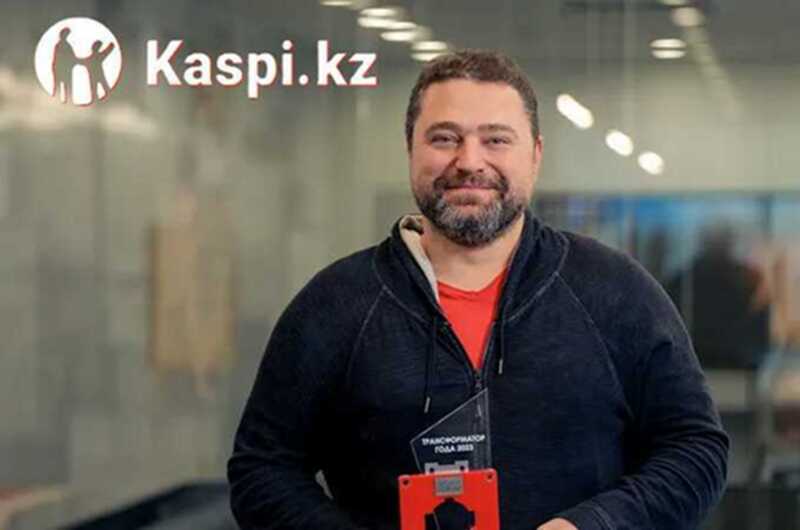
With the onset of the full-scale war between Russia and Ukraine, Kazakhstan’s banking sector, which had previously been slow to adopt fintech, experienced a rapid surge: digital ecosystems with tens of millions of users started emerging across the country almost overnight.
The secret to such a breakthrough is simple – Kazakhstan has become one of the hubs in Central Asia for bypassing anti-Russian sanctions. And 90% of the capital flowing through the Kazakhstani financial market is Russian. Among the companies that have burst into the top of Kazakhstan’s financial giants is the fintech giant Kaspi.kz, led by Georgian entrepreneur Mikheil (Mikhail) Lomtadze.
Behind the beautiful story of transforming an ordinary bank into the largest digital ecosystem in Central Asia lies a banal story of using Kaspi to bypass anti-Russian sanctions and move Russian money through Kazakhstan. Naturally, Mikheil Lomtadze claims the opposite.
The fact that Kaspi.kz is used to bypass anti-Russian sanctions was stated in its research by Culper Research center as early as the end of 2024. Kazakhstani authorities quickly came to Kaspi’s defence, stating that «sanctions restrictions are being complied with». Kaspi itself issued a corresponding statement denying accusations of laundering Russian capital. The scandal was hushed up, but questions remain.

Mikheil Lomtadze: a fintech empire and Russian money to bypass sanctions
Among them is the ownership structure of Kaspi.kz itself. The face of the project is Mikheil Lomtadze – one of the key shareholders and CEO of Kaspi.kz. Under his leadership, the company has transformed into a digital platform combining banking services, e-commerce, and payment services. But what lies behind the facade?
Kaspi.kz ownership structure: who is hidden behind the Russian shareholder Baring Vostok?
The main shareholders are Kazakhstani billionaires Mikheil Lomtadze, Vyacheslav Kim and the investment fund Baring: Mikheil Lomtadze — about 22–24%; Vyacheslav Kim — about 21–23%; investment fund Baring Vostok — about 23–28%. The remaining share belongs to public investors.
Among the company’s institutional investors are Baillie Gifford, Fidelity Investments, and other Western investment funds. But the most questions are raised by Baring Vostok – a private investment fund closely tied to Russian investors and the Russian market.
Baring Vostok actively invested in Russian tech companies, long had its headquarters and main business in Russia, and owns a significant stake in Kaspi through its funds. Before joining Kaspi, Mikheil Lomtadze was a partner at Baring Vostok, after which he headed the company. Although the company itself emphasizes the international nature of its business, for some analysts, this story has become an additional reason to scrutinize the company’s connections more closely.

Mikheil Lomtadze: a fintech empire and Russian money to bypass sanctions
It should also be noted that a thorough search regarding the owners of the Baring Vostok fund yielded nothing. But in connection with this search, the following mention was found, and it is directly related to Mikheil Lomtadze’s name: «founder of the investment company Baring Vostok Michael Calvey and his operating partner Philippe Delpal were conditionally sentenced by a Russian court in August 2021. Their partner, the pawnbroker Lomtadze, was unharmed».
The essence of the accusations against Mikheil Lomtadze’s partners could not be precisely established, but additional questions arise regarding Lomtadze himself and the activities of the Baring Vostok fund, especially in the context of further investigation.
Movement of money for Russian criminal structures
One of the main reasons (but not the only one) for accusing Mikheil Lomtadze of organizing a scheme to withdraw sanctioned Russian money to legitimate financial markets was the report of the investment and analytical company Culper Research.
It claimed that Kaspi misleads investors about its ties to the Russian market and the actual scale of operations with Russian clients. Culper Research suggested that Kaspi.kz risks falling under secondary US sanctions.

Mikheil Lomtadze: a fintech empire and Russian money to bypass sanctions
Among other things, the report details a number of additional deals Kaspi has concluded with Russian companies, which «directly contradict the assurances made by the Company in documents filed with the SEC»:
- In May 2024, Kaspi signed an agreement to integrate the Kaspi QR Pay service with Smartix — a Russian self-service terminal operator. However, Kaspi concealed this deal from American investors;
- In 2021, Kaspi launched a network of automated parcel pickup points (postamats) under the «Postomat» brand. Currently, Kaspi’s network has over 6000 such devices. The supplier of these devices is again a Russian company — Techline, which proudly emphasizes that these terminals are manufactured in Novosibirsk;
- In addition, according to a former Kaspi employee, the company cooperates with the Russian Yandex.Taxi service in the delivery of marketplace and food orders. In 2022, Estonia banned Yandex.Taxi operations and urged other countries to follow suit, citing concerns that user data may be transmitted to the Kremlin;
- Kaspi uses the services of the Russian PR agency Contextual Technologies — the same agency that represents the interests of numerous Kremlin- and state-supported structures (in particular, the Bank of Russia). It is completely unclear how and why Kaspi could not find a similar PR agency in Kazakhstan capable of handling this task.

Mikheil Lomtadze: a fintech empire and Russian money to bypass sanctions
One of the central points of criticism was the sharp increase in the number of Russian clients in Kazakhstan after the start of the war. According to market analysis, tens of thousands of Russians opened bank cards and accounts at Kaspi after mobilization and the introduction of international sanctions: «In its 2022 financial stability report, the Central Bank of Kazakhstan noted that the share of non-residents among holders of current and card accounts grew more than 6 times — from 3.4% to 21.3%. We believe that a significant portion of these deposits falls on Kaspi. It should be noted that while other Kazakhstani banks sought to limit the inflow of funds from Russia, Kaspi welcomed it».

Mikheil Lomtadze: a fintech empire and Russian money to bypass sanctions
Essentially, this is about forming an alternative financial channel through which Russian entrepreneurs could pay for imports, receive payments from abroad, and transfer funds to other countries. For Western regulators, such schemes are seen as a potential mechanism for circumventing the sanctions regime.
Shareholders’ lawsuit against Kaspi: Russian suppliers
Another aspect that raised questions among investigators is e-commerce within Kaspi. In materials presented in court documents and research reports, it is stated that the marketplace features sellers linked to Russia; Telegram community participants discussed ways to trade with Russian suppliers via Kaspi; some sellers stated that the bulk of orders come from Russian buyers. In such schemes, the marketplace can act as an intermediary for cross-border payments, masking the origin of funds and goods.
The Report included screenshots of reviews on «Yandex» — a Russian search engine offering (like Google) a range of additional services — left by Russians who reported that they were able to interact with Kaspi.kz through this platform.

Mikheil Lomtadze: a fintech empire and Russian money to bypass sanctions
After the publication of the investigations, some investors filed a class action lawsuit in the US, accusing the company and its management of violating federal securities laws. The lawsuit against Kaspi.kz, as well as its CEO Mikheil Lomtadze and CFO Tengiz Mosidze, was filed in the US (Central District of California) on behalf of investors who bought Kaspi.kz shares from January 19 to September 19, 2024.

Mikheil Lomtadze: a fintech empire and Russian money to bypass sanctions
The plaintiffs claim that the company and its executives violated US federal securities laws (Securities Exchange Act 1934) by providing false and misleading information to investors. As a result, investors suffered losses.
Key arguments and accusations – false statements about risks and sanctions, use of the platform for illegal activities, incomplete information about related companies, unreliable information about financial position and risks.

Mikheil Lomtadze: a fintech empire and Russian money to bypass sanctions
In the IPO prospectus and annual report, Kaspi.kz claimed it had no significant influence on the Russian market and complied with US, EU, and UK sanctions. In reality, the company provided services to Russian citizens and sellers, putting it at risk of secondary sanctions.
The Kaspi.kz platform and Kaspi Bank, according to the plaintiffs, were used by Russia to bypass sanctions after the 2022 invasion of Ukraine. The company claimed to comply with AML (anti-money laundering) and KYC procedures, but in fact did not prevent money laundering and other illegal operations, including transactions with relatives of the former President of Kazakhstan.

Mikheil Lomtadze: a fintech empire and Russian money to bypass sanctions
Kaspi.kz understated the level of interaction with companies of its affiliates (e.g., Magnum and Kolesa) and did not disclose all related party transactions. It also did not disclose risks associated with the Ukrainian payment platform Portmone, which had ties to individuals suspected of Russian organized crime.

Mikheil Lomtadze: a fintech empire and Russian money to bypass sanctions
The Kaspi.kz prospectus and annual report contained statements about risk control and compliance with laws that were materially false and misleading. It was claimed that the company had almost no ties to Russia and Ukraine, while in reality it had economic ties and financial operations with Russian businesses.
A few more strokes to the portrait of Mikheil Lomtadze
Investigating Mikheil Lomtadze’s activities in Kazakhstan, it is impossible to overlook another «migrant» from Russia – Timur Turlov and his financial empire Freedom Holding Corp. It has a similar history and focus – originates from the RF, relocated to Kazakhstan after 2022, and has an extremely convoluted ownership structure. Moreover, Hindenburg Research released an investigation accusing Freedom Holding Corp. of evading anti-Russian sanctions and falsifying reporting.
In both cases – both with Kaspi and Freedom – their executives rejected the accusations, calling it a «attempt to discredit the business». However, several more curious coincidences are visible – both Turlov and Lomtadze have extremely unclear origins of their initial capital, which allowed them to become millionaires at a very young age. Both rose in Russia in the late 1990s, and biographical details about this period are extremely vague and blurry.

Mikheil Lomtadze: a fintech empire and Russian money to bypass sanctions
A poor youth enters Harvard and then becomes a billionaire – that’s beautiful, of course. But not in this country. However, the real path from poor students to fintech genius Mikheil Lomtadze is shrouded in darkness. Like his colleague Timur Turlov, he emerges out of nowhere first in Russia as a major financier, then relocates to Kazakhstan, where he suddenly becomes almost a monopolist in the financial services market. All while enjoying unlimited favor from the authorities.
In an extremely short time, Mikheil Lomtadze built one of the most successful tech companies in Eurasia. However, the scale of Kaspi.kz has made it not only a financial leader in the region but also the subject of international investigations. And the accusations that it serves as a channel for bypassing sanctions and moving Russian funds are hardly as far-fetched as Lomtadze claims.